Istrian wine: Malvazija, Teran and how to taste them
By the Enjoy Istria team Published 3 min read
In short
Istria's signature wines are Malvazija istarska, a fresh, mineral white, and Teran, a deep red with lively acidity. Most are made by family wineries in the hills between Buje, Momjan, Motovun and Poreč, and the easiest way to taste them is to book a short cellar visit or order local wine by the glass in a konoba.
On this page
Istria is a small peninsula with a big wine culture. Vineyards run from the coast up into the hills, and almost every village has a family that makes wine. You will find Istrian wine on every menu, often served by the glass or in a carafe, and much of it never leaves the region.
The grapes to know
Malvazija istarska
The white Malvazija istarska (Istrian Malvasia) is the region’s most planted grape and the one to try first. Young Malvazija is pale, fresh and lightly aromatic, with notes of apple, pear and acacia, and a slightly salty finish that suits seafood. Some producers age it in oak or acacia barrels or leave it in contact with the skins, which gives fuller, golden wines that work with richer dishes.
Teran
Teran is the traditional red. It is dark in colour, juicy and high in acidity, with flavours of red berries and a hint of spice. Locals drink it with pršut, sausages, game and truffle pasta. Its acidity makes it feel fresh even in summer, served slightly cool.
Muškat momjanski
Around the village of Momjan, in the north-west near the Slovenian border, growers make Muškat momjanski, an aromatic, usually sweet or semi-sweet muscat. Try it with dessert or with cheese.
Refošk and international grapes
Refošk is a red relative of Teran, softer and rounder. Many wineries also grow Merlot, Cabernet Sauvignon, Chardonnay and Pinot varieties, and blend them with local grapes.
Where the wine villages are
Most well-known producers are in the north-west and centre of the peninsula: around Buje, Momjan, Brtonigla and Novigrad, along the Mirna valley below Motovun, and in the hills behind Poreč and Višnjan. All are within roughly 15 to 50 minutes’ drive of our villas.
Look out for brown tourist signs marking wine roads and for small boards at farm gates saying vino or prodaja vina (wine for sale).
How a cellar visit works
- Book ahead. Most wineries are run by families. Call, email or message a day or two before.
- Expect a tasting of three to six wines, often with bread, olive oil, cheese or pršut. Tastings are usually paid.
- Agree on a driver. Croatian drink-drive limits are strict, and lower for young and professional drivers. Plan two or three wineries close together rather than a long tour.
- Buy at the cellar. Prices are fair, and many producers sell bottles you will not find in shops.
When to go
- May: the Vinistra wine fair, held in Poreč since 1994, opens the season, followed by an open cellars day when many wineries welcome visitors.
- September and October: harvest time. Vineyards are busy and the light is beautiful.
- Summer: tasting rooms keep their longest hours, but book ahead in August.
Wine with food
| Wine | Try it with |
|---|---|
| Young Malvazija | Grilled fish, scampi, Lim bay oysters, salads |
| Aged or skin-contact Malvazija | Truffle pasta, risotto, white meat |
| Teran | Pršut, sausages, game, steak with truffles |
| Muškat momjanski | Fritule, cakes, blue cheese |
For local food to go with it, see our list of Istrian dishes to try and our guide to olive oil.
Stay nearby
Our three villas are on the Poreč side of the wine country. Villa Bina and Villa Cvita Domenica are in Labinci, among olive groves and vineyards, and Villa Duga is just north of Poreč. All three have outdoor kitchens or barbecues, so you can open your new bottles over dinner at home.
Opening times, timetables and prices change from year to year, so check them with the venue before you go.
Questions and answers
What is the most typical Istrian wine?
Malvazija istarska (Istrian Malvasia), a dry white grape that is the most widely planted variety in Istria. It ranges from light and fresh to rich, barrel-aged and skin-contact styles.
What is Teran?
Teran is Istria's traditional red grape. It gives dark, fruity wines with high acidity that go well with pršut, game and truffle dishes.
Can you visit wineries in Istria without booking?
Some wineries have tasting rooms with opening hours, especially in summer, but most are family businesses. Call or message a day ahead so someone is there to welcome you.
When is the best time for wine in Istria?
May, when the Vinistra wine fair is held in Poreč and wineries open their cellars, and September to October, around the grape harvest.
Stay nearby
Three private pool villas near Poreč, booked directly with the owners for 10% less than on Booking.com.
-
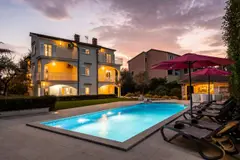 Villa Duga Špadići, Poreč From €459 / night
-
 Villa Bina Labinci, Poreč From €459 / night
-
 Villa Cvita Domenica Labinci, Poreč From €309 / night