20 Croatian phrases for your Istria holiday
By the Enjoy Istria team Published 2 min read
In short
Most people in Istria working with visitors speak English, German or Italian, but a few words of Croatian are always appreciated. Learn dobar dan (good day), hvala (thank you), molim (please) and račun, molim (the bill, please), and remember that Istria is officially bilingual, so you will also see Italian on signs.
On this page
You can get through a holiday in Istria without a word of Croatian. Most people in shops, restaurants and tourist services speak English, German or Italian. But greeting people in their own language opens doors, earns smiles and sometimes a free glass of rakija. Here are the phrases our guests find most useful.
How to pronounce Croatian
Croatian is written as it sounds: one letter, one sound. The letters that differ from English:
| Letter | Sounds like |
|---|---|
| c | ts, as in cats |
| č, ć | ch, as in church |
| š | sh, as in shop |
| ž | s in pleasure |
| j | y, as in yes |
| dž, đ | j, as in jam |
| r | rolled, and can act as a vowel (Krk) |
Greetings and basics
- Dobar dan (DOH-bar dahn) – Good day / hello
- Dobro jutro (DOH-broh YOO-troh) – Good morning
- Dobra večer (DOH-brah VEH-chehr) – Good evening
- Bok (bohk) – Hi / bye (informal)
- Doviđenja (doh-vee-JEH-nyah) – Goodbye
- Molim (MOH-leem) – Please; also “you’re welcome” and “pardon?”
- Hvala (HVAH-lah) – Thank you
- Da / Ne (dah / neh) – Yes / No
- Oprostite (oh-PROH-stee-teh) – Excuse me / sorry
- Govorite li engleski? (GOH-voh-ree-teh lee EN-gleh-skee) – Do you speak English?
At the restaurant
- Stol za šest, molim (stohl zah shest) – A table for six, please
- Jelovnik, molim (YEH-lohv-neek) – The menu, please
- Čaša vina / pivo (CHAH-shah VEE-nah / PEE-voh) – A glass of wine / a beer
- Voda (VOH-dah) – Water
- Račun, molim (RAH-choon, MOH-leem) – The bill, please
- Živjeli! (ZHEE-vyeh-lee) – Cheers!
Shopping and getting around
- Koliko košta? (KOH-lee-koh KOH-shtah) – How much is it?
- Gdje je…? (gdyeh yeh) – Where is…?
- Plaža (PLAH-zhah) – Beach
- Ljekarna (LYEH-kar-nah) – Pharmacy
Words you will see on signs
- Prodaja – For sale (on farm gates: wine, olive oil, honey)
- Otvoreno / Zatvoreno – Open / Closed
- Ulaz / Izlaz – Entrance / Exit
- Konoba – A traditional tavern (see what is a konoba)
- Ribarnica – Fish market
- Tržnica – Market
Italian in Istria
Istria has a long Italian heritage, and in many towns along the west coast Italian is an official language alongside Croatian. Road signs and town names often appear in both: Poreč / Parenzo, Novigrad / Cittanova, Rovinj / Rovigno. If you speak Italian, you will often be understood.
A few local words
Istrians speak their own regional dialects, mixing Croatian and Venetian words. You may hear fuži (the local pasta), bukaleta (a ceramic wine jug) and maneštra (a thick vegetable soup) on menus. Our guide to Istrian dishes explains what to order.
Ask us anything
We answer messages in English, German, Italian and Croatian. If you are staying at Villa Duga, Villa Bina or Villa Cvita Domenica, just ask us how to say something. Or try it on us: dobar dan!
Opening times, timetables and prices change from year to year, so check them with the venue before you go.
Questions and answers
Do people speak English in Istria?
Yes, widely in tourism, especially among younger people. German and Italian are also common, and Italian is an official language in parts of Istria.
How do you say thank you in Croatian?
Hvala (HVAH-lah). Hvala lijepa (HVAH-lah LYEH-pah) means thank you very much.
Is Croatian hard to pronounce?
It is spelled phonetically: each letter has one sound. Learn a few special letters, such as č and ć (ch), š (sh), ž (like the s in pleasure) and j (y), and you can read most words aloud.
Stay nearby
Three private pool villas near Poreč, booked directly with the owners for 10% less than on Booking.com.
-
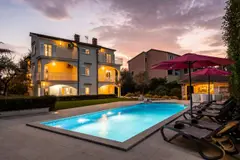 Villa Duga Špadići, Poreč From €459 / night
-
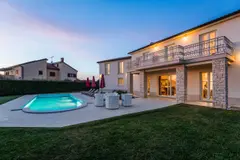 Villa Bina Labinci, Poreč From €459 / night
-
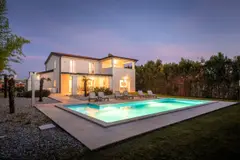 Villa Cvita Domenica Labinci, Poreč From €309 / night